
A common misconception is that a “privacy wallet” is simply a wallet with a privacy coin selected in its menu. It is not. A Litecoin wallet, an XMR wallet, and software associated with Haven Protocol can serve very different purposes, even when they appear together in the same cryptocurrency conversation. The important distinction is not the app’s branding; it is the transaction model operating underneath it.
Litecoin is generally valued for straightforward payments and a mature, transparent blockchain. Monero, represented by the ticker XMR, is designed around transaction privacy. Haven Protocol took ideas from Monero and attempted to build a broader private monetary system with additional assets. These are related concepts, but they are not interchangeable. For a US user choosing a wallet, confusing them can lead to the wrong address format, unsupported assets, misplaced trust, or an inaccurate assumption that a normal Litecoin transfer is private.
The first correction: a wallet does not create blockchain privacy
A cryptocurrency wallet is best understood as key-management and transaction-construction software. It stores, or helps control, the cryptographic keys needed to spend funds. It also derives addresses, checks balances, prepares transactions, and communicates with a network or a wallet server. The blockchain itself determines what information is visible and how transactions can be analyzed.
That boundary matters. A Litecoin wallet can improve operational security by keeping keys encrypted, supporting hardware devices, or reducing exposure to untrusted websites. It cannot make Litecoin’s ordinary transparent ledger behave like Monero’s privacy system. Litecoin transactions generally reveal inputs, outputs, and amounts to observers of the chain, although optional privacy-related features may exist in particular implementations or transaction types. “The wallet supports privacy” is therefore an incomplete statement. The useful question is: privacy against whom, at which layer, and under what conditions?
Monero approaches the problem at the protocol level. Its transaction design uses mechanisms intended to obscure the sender, recipient, and amount from ordinary blockchain observers. A compatible XMR wallet must handle those mechanisms, maintain the relevant wallet view of the chain, and construct transactions according to Monero’s rules. This creates a sharper privacy model than simply hiding an address behind a password, but it also makes Monero wallets more specialized than many multi-currency wallets.
What an XMR wallet actually has to do
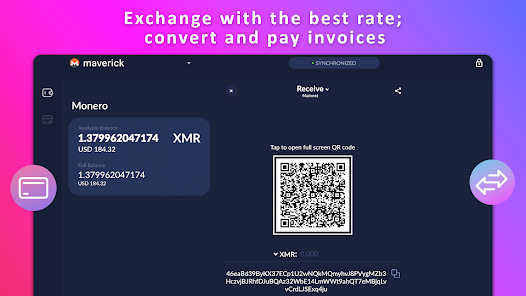
An XMR wallet is not merely a balance display with an XMR logo. Monero uses a view key concept that allows a wallet to scan blockchain data for incoming transactions without necessarily granting spending authority. That separation can be useful for accounting, auditing, or watch-only arrangements, but it introduces more key-management decisions than a basic transparent-chain wallet. A user must understand which secrets are for viewing, which are for spending, and which backup restores each capability.
There is another practical complication: wallet privacy depends partly on network behavior. A wallet may connect directly to a node, use a remote node, or rely on an intermediary service. Each approach involves trade-offs. Running a personal node offers stronger control over information sent to third parties, but requires storage, bandwidth, maintenance, and technical patience. A remote node is easier, yet it may learn metadata such as connection details or wallet-related requests. Protocol privacy can reduce what is visible on-chain without eliminating all off-chain identification.
This is why a multi-currency application can be useful but should not be treated as automatically equivalent to a dedicated Monero wallet. One interface may simplify portfolio management across Bitcoin, Litecoin, Monero, and other assets. The cost of that convenience is a larger software surface, more complicated updates, and a need to verify which features are implemented natively rather than routed through a third-party service. If evaluating a product such as cake wallet, examine its supported networks, recovery process, node options, and release history rather than relying only on the privacy label.
Where Litecoin fits—and where it does not
A Litecoin wallet can still be a sensible tool for users who want a relatively simple payment asset or a separate account for everyday transfers. Litecoin’s transparent accounting model can make transaction verification and balance reconciliation easier. It may also be supported by more exchanges, payment services, and hardware devices than some privacy-focused assets. Those are practical advantages, not failures of privacy design.
The limitation is that transparent settlement creates a different privacy burden. If an address is connected to a real-world identity through an exchange, merchant, public donation page, or reused address, blockchain observers may be able to follow related activity. Even without identifying a person immediately, transaction graphs can expose relationships among addresses and amounts. A new address can reduce accidental linkage, but it does not transform Litecoin into an anonymity system.
Users should also distinguish confidentiality from security. A hardware wallet can protect private keys from many forms of malware, but it does not hide a transaction’s public ledger data. Encryption of a wallet file protects stored secrets, but not a payment once it is broadcast. Privacy, custody, and device security overlap in practice, yet they solve different problems. A strong wallet decision treats them as separate controls.
Why Haven Protocol complicates the picture
Haven Protocol is often mentioned alongside Monero because it was built around privacy-oriented technology and explored a system of native and synthetic assets. In broad terms, its ambition was to extend private transactions beyond a single currency, allowing users to represent different forms of value within a privacy-focused ecosystem. That makes Haven conceptually relevant to anyone interested in multi-currency privacy, but it does not mean that an ordinary XMR wallet or Litecoin wallet automatically supports Haven assets.
The mechanism creates additional risk. A synthetic asset is not the same thing as a bank deposit, a regulated dollar, or a reserve held in a conventional account. Its value depends on protocol rules, collateral assumptions, price data, incentives, software execution, and market liquidity. Even if the underlying privacy technology works as designed, an economic layer can fail through flawed assumptions, manipulation, insufficient liquidity, or an unexpected interaction between components.
Haven also illustrates a broader lesson: privacy and monetary stability are separate engineering problems. Monero’s central challenge is private, reliable peer-to-peer settlement. A system that tries to add private representations of multiple assets must also manage pricing, conversion, redemption, and confidence. Those extra functions expand the possible failure modes. Anyone researching Haven should verify the current network condition, wallet compatibility, liquidity, and development status directly before moving funds; historical descriptions of a protocol are not proof that its present infrastructure remains usable or secure.
A reusable wallet-selection framework
Before installing software, classify the job. For long-term savings, prioritize key ownership, backup testing, hardware support, and a recovery process you can perform offline. For routine Litecoin payments, look for clear fee controls, address labeling, and broad compatibility. For Monero, investigate view-key handling, synchronization behavior, node privacy, and whether the wallet is designed specifically for XMR rather than merely listing it among many assets.
Then test the recovery path with a small amount. A wallet that appears polished can still be unsuitable if its seed format is unclear, its backup cannot be restored independently, or its transaction history depends on one service. Keep software updated through trusted channels, avoid entering a recovery phrase into a website, and separate large balances from experimental protocols. In the US, also remember that privacy technology does not remove tax, reporting, sanctions, or other legal obligations. Better privacy can reduce unnecessary public exposure; it does not make ownership or use exempt from applicable rules.
There is no recent project-specific news available for the current or latest eligible week, so readers should resist treating a quiet news cycle as evidence of safety or inactivity. The more useful signals to watch are concrete: reproducible software releases, transparent incident handling, active network support, wallet synchronization reliability, node availability, and whether exchanges or services continue to handle an asset responsibly. If those signals weaken, the practical case for holding or using a specialized asset may change even when its original technical idea remains interesting.
FAQ
Can a Litecoin wallet hold Monero?
Only if the software explicitly supports Monero and implements its wallet and transaction rules correctly. A Litecoin address and an XMR address are not interchangeable. Multi-currency support should be verified by asset-specific documentation, not inferred from a shared app interface.
Is an XMR wallet completely anonymous?
No wallet can guarantee complete anonymity. Monero is designed to provide strong on-chain privacy, but network connections, exchange records, device fingerprints, address-sharing habits, and user behavior can still create identifying information. Privacy is a system property with limits, not a magic setting.
Does Haven Protocol replace the need for an XMR wallet?
No. Haven and Monero are distinct systems, even where they share technical ideas or historical relationships. Compatibility depends on the specific asset, network, and wallet implementation. Treat Haven-related holdings as a separate research and operational risk, especially because synthetic assets add economic assumptions beyond ordinary cryptocurrency custody.
The clearest mental model is simple: the wallet controls keys, the protocol defines transaction visibility, and the surrounding network determines how much metadata can still leak. Litecoin, Monero, and Haven Protocol occupy different points in that design space. Choosing securely begins not with the most persuasive privacy claim, but with identifying which problem you are actually trying to solve—and checking where the chosen system can still break.